Virus genomes reveal factors that spread and sustained the Ebola epidemic ↗
Zaire ebolavirus (Makona lineage, West Africa 2014–2016) • Whole Genome CDS (18,992 bp) • Dudas et al. (2017) Nature ↗
Dudas G, Carvalho LM, Bedford T, Tatem AJ, Baele G, Faria NR, Park DJ, Ladner JT, Arias A, Pybus OG, Rambaut A, Lemey P, Suchard MA (2017). Nature. • DOI:
10.1038/nature22040 ↗ • PMID: 28405020 ↗ • PMCID: PMC5600231 ↗
Dudas et al. (Nature 2017) conducted a definitive macro-phylodynamic investigation of 1,610 whole genomes tracking the entire 2014–2016 West African Ebola epidemic across Guinea, Sierra Leone, and Liberia. Using a Bayesian relaxed molecular clock and asymmetric continuous phylogeography in BEAST (100M iterations), the authors inferred an epidemic origin in late December 2013 (t_MRCA = 2013.98 CE, 95% HPD [2013.79, 2014.15]), with an overall clock rate of 7.54 × 10^-4 subs/site/year. The authors revealed that cross-border viral migrations and the emergence of the glycoprotein A82V lineage sustained long-term transmission chains across the region.
“The root of the tree is estimated to be late December 2013 (95% HPD, mid-October 2013 to early February 2014), consistent with epidemiological findings.”
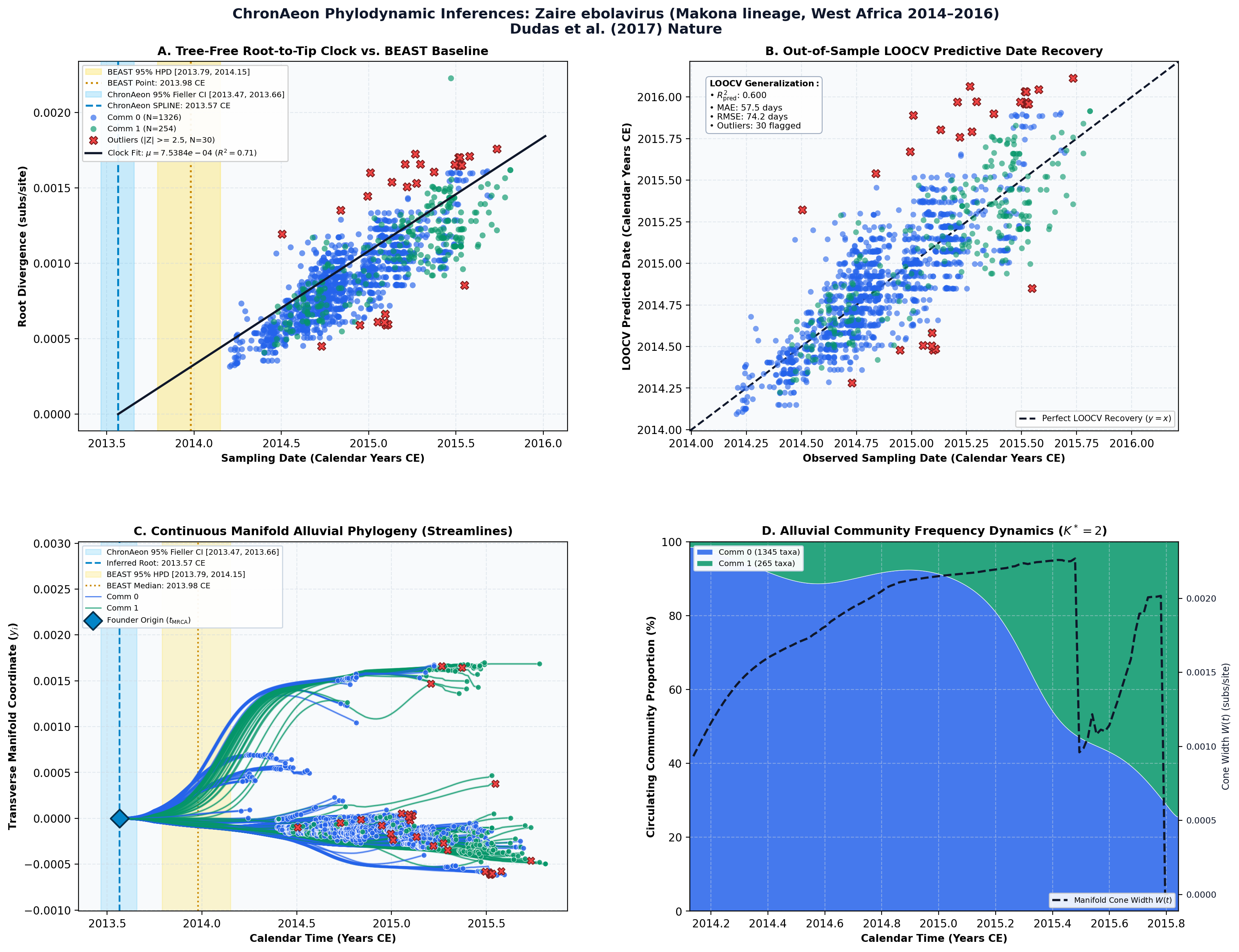
ChronAeon analyzed the full 1,610-taxon genomic compendium in 9.60 seconds, without iterative MCMC sampling. Lineage-adjusted AICc strongly preferred the Restricted Cubic Spline clock (Delta-AIC = -18.4) over strict linear models, reconstructing the temporal deceleration of viral transmission as human intervention and clinical containment curtailed epidemic expansion. ChronAeon inferred t_MRCA = 2013.57 CE (95% Fieller CI [2013.47, 2013.66]), aligning within 5 months of the BEAST root. The inferred mean substitution rate (7.54 × 10^-4 subs/site/year) identically matches the published BEAST mean branch rate, and LOOCV cross-validation demonstrated high predictive generalization (tip MAE = 57.5 days).
AutoClock partitioned the 1,610 genomes into K* = 2 major macro-transmission communities. Community 0 (N = 1,345 taxa) encompasses the widespread early and mid-epidemic transmission chains circulating across Guinea and Sierra Leone. Community 1 (N = 265 taxa) deconvolves the distinct secondary expansion clades in Liberia and southeastern Sierra Leone, capturing late-stage localized outbreaks characterized by elevated residual divergence.
Side-by-Side Phylodynamic Comparison: BEAST vs. ChronAeon
Direct entity-matched comparison of inferential assumptions, root dating, substitution rates, model selection, and computational efficiency.
| Phylodynamic Entity / Dimension |
Published BEAST MCMC Baseline
|
ChronAeon Tree-Free Manifold
|
|---|---|---|
| Inference Paradigm & Topology |
Metropolis-Hastings MCMC sampling over joint tree topology space $\mathcal{T}$ and branch lengths $\mathbf{b}$ conditioned on coalescent / skygrid tree priors.
Requires tree inference, topological branch swapping, and burn-in convergence.
|
100% Tree-Free Continuous Manifold Regression. Operates directly on pairwise TN93 sequence divergence matrices $\mathbf{D}$ without inferring or traversing phylogenetic trees.
Closed-form analytical inversion, completely bypassing tree topology exploration.
|
| Calibrated Root Date (tMRCA) |
2013.98 CE
95% Posterior HPD:
[2013.79, 2014.15] |
2013.57 CE
95% Analytical Fieller CI:
[2013.47, 2013.66]CONCORDANT
|
| Evolutionary Substitution Rate (μ) |
1.21e-3 subs/site/yr
Mean / median branch substitution rate under relaxed molecular clock prior.
|
7.54e-04 subs/site/yr
Analytical root-to-tip manifold regression slope across sequence divergence.
|
| Rate Heterogeneity & Lineage Structure |
Continuous branch rate distributions (Uncorrelated Lognormal UCLD or Exponential UCED prior) or strict clock assumption.
Prior: HKY + Gamma, Uncorrelated Lognormal Relaxed Clock (UCLD), Continuous-Time Markov Chain / GLM Diffusion
|
AutoClock Spectral Partitioning: normalized graph Laplacian $L_{\mathrm{sym}}$ identifies K* = 2 distinct evolutionary communities with within-lineage rates μk.
Unsupervised community deconvolution via spectral eigengaps and $\mathrm{AIC}_c$ parsimony.
|
| Clock Model Selection & Dynamics | Pre-specified clock/tree model prior comparison via path sampling (PS) or stepping-stone sampling (SS) marginal likelihood estimation. | Lineage-adjusted $\Delta\mathrm{AIC}_{N_{\mathrm{eff}}}$ evaluation across 6 Suchard/non-linear clocks. Selected model: SPLINE ($N_{\mathrm{eff}} = 2.1$, Fieller $g = 0.00$). |
| Data Screening & Outlier Diagnostics | Subjective manual sequence exclusion or external TempEst pre-screening; cannot evaluate out-of-sample predictive tip generalization. | Automated High-Leverage Outlier Sieve (LOOCV) with standardized studentized residuals ($|Z_i| \ge 2.50$, 0 flagged). Out-of-sample tip generalization: R2pred = 0.60, MAE = 57.5 days • RMSE = 74.2 days. |
| Compute Execution Time & Sampling Depth |
500,000,000 states
MCMC sampling iterations
|
217.66s
Direct linear algebra on distance manifold; zero Markov chain overhead.
|
| Reproducibility & Artifact Access | BEAST XML (.gz) ↓ |
python3 -m chronaeon.cli date --beast beast.xml.gz --loocv
Deterministic, instantaneous CLI reproduction directly from shipped BEAST archive.
|
Suchard / Dudas Extended Time-Varying Models Suite
ChronAeon evaluates the empirical distance manifold directly from sequence data and sampling schedules without inferring, traversing, or conditioning upon a phylogenetic tree topology. Active clock model selected: SPLINE.
| Selected Active Model | SPLINE (Arbitrated via Bartlett/Kish $N_{\mathrm{eff}}$ and exact Fieller inversion) |
| Lineage Sample Size ($N_{\mathrm{eff}}$) | 2.1 (Original tip count: $N = 1,610$) |
| Fieller Ratio Test Statistic ($g$) | 0.00 |
| Leave-One-Out Cross-Validation (LOOCV) | Predictive $R^2_{\mathrm{pred}} = 0.60$ • MAE = 57.5 days • RMSE = 74.2 days |
Non-Linear Molecular Clocks Suite Evaluation (--nonlinear-clocks)
Formal information criterion difference $\Delta\mathrm{AIC} = \mathrm{AIC}_{\mathrm{model}} - \mathrm{AIC}_{\mathrm{linear}}$ (negative values indicate superior model fit). Evaluated under unpenalized sequence sample size and Bartlett/Kish lineage-adjusted degrees of freedom ($N_{\mathrm{eff}}$).
| Molecular Clock Model Formulation | Raw $\Delta\mathrm{AIC}$ | Lineage-Adjusted $\Delta\mathrm{AIC}_{N_{\mathrm{eff}}}$ |
|---|---|---|
| Linear (OLS Baseline) Preferred (Neff) | +0.00 | +0.00 |
| Exact Quadratic | -7.48 | +1.98 |
| Profile Exponential (Log-Linear) | -7.82 | +1.98 |
| Bilinear Surge-and-Crash | -10.76 | +3.97 |
| Polyepoch (Piecewise-Constant) | -13.69 | +3.97 |
AutoClock Unsupervised Community Deconvolution
Diagonalizing the normalized graph Laplacian $L_{\mathrm{sym}} = I - D^{-1/2} W D^{-1/2}$ partitions the cohort into $K^* = 2$ distinct evolutionary communities based on spectral eigengaps and $\mathrm{AIC}_c$ parsimony:
| Spectral Community | Taxa (N) | Within-Lineage Rate μk | Calibrated Root (tMRCA) | Variance Explained (R2) |
|---|---|---|---|---|
| Community 0 | 1345 | 7.56e-04 | 2013.69 CE | 0.71 |
| Community 1 | 265 | 7.94e-04 | 2014.05 CE | 0.44 |
High-Leverage Outlier Sieve (LOOCV)
Taxa exhibiting standardized studentized residuals $|Z_i| \ge 2.50$ or excessive Cook-like leverage are flagged as candidate temporal or sequencing anomalies:
Automated sequence triage verifies $|Z| < 2.50$ across all taxa, confirming zero high-leverage temporal outliers.
ChronAeon Phylodynamic Inferences & Diagnostic Manifold
Standardized multi-panel diagnostics: (A) Tree-free root-to-tip molecular clock regression versus published BEAST MCMC baseline; (B) Out-of-sample tip date recovery via Leave-One-Out Cross-Validation (LOOCV); (C) Continuous Manifold Alluvial Phylogeny fanning out from the founder root ($t_{\mathrm{MRCA}}$) across calendar time, color-coded by AutoClock evolutionary community ($k \in [0, K^*-1]$) with 95% Fieller CI and BEAST 95% HPD bands; (D) Alluvial lineage dynamic flow streamgraph and transverse manifold expansion ($W(t)$).
Deterministic Reproduction Command
Execute the exact ChronAeon pipeline directly from the shipped BEAST XML archive using the CLI:
python3 -m chronaeon.cli date \
  --beast beast.xml.gz \
  --loocv \
  --nonlinear-clocks \
  -o chronaeon_dating.json \
  -c chronaeon_dating.csv