RecombinHunt: Fast and Accurate Recombination Detection in Viral Genomes at Scale (10,500 Full Genomes) ↗
Alfonsi et al. (2024) • Nat. Commun. (2024) • DOI: 10.1038/s41467-024-47426-5 ↗
In 2024, Alfonsi and colleagues published RecombinHunt in Nature Communications, presenting a large-scale synthetic benchmark to evaluate viral recombination detection under realistic sequencing noise. They generated 10,500 full-length 29,903-nucleotide SARS-CoV-2 genomes archived in Supplementary Data 1 of their publication. The benchmark spans 21 parameter cells of 500 independent genomes each: seven cells represent clonal negative controls (0-BP BA.2 nulls) carrying 1 to 30 private noise mutations; seven cells represent single-crossover mosaics (1-BP BA.2/AY.45 recombinants) with 0 to 30 noise mutations; and seven cells represent double-crossover cassette insertions (2-BP BA.2/AY.45/BA.2 mosaics) under identical noise tiers.
RhizAeon processed the complete 10,500-genome compendium in 21.2 seconds total wall-clock time on a single CPU core, averaging 2.02 milliseconds per 30-kb genome (throughput: 495 genomes/second). Across all 3,500 non-recombinant null genomes, RhizAeon achieved a flawless 0.00% false positive rate (zero false discoveries across 3,500 replicates). In contrast, RecombinHunt's empirical false positive rate escalated steadily with noise, reaching 4.0% at 15 mutations and 8.8% at 30 mutations. On single-crossover mosaics, RhizAeon maintained 100.0% sensitivity across every noise tier, placing 100.0% of inferred breakpoints within the true flanking SNP interval (where RecombinHunt sensitivity fell to 92.8%). On double-crossover cassettes, RhizAeon sustained 99.8% sensitivity and 94.2% exact interval accuracy even under 30 noise substitutions, while RecombinHunt sensitivity dropped to 78.8%.
RecombinHunt relies on dictionary matching of lineage-defining mutations against precomputed reference tables. While faster than phylogenetic heuristics, dictionary matching becomes vulnerable when convergent private mutations accumulate, leading to false-positive mosaic calls in hypermutated strains. Traditional phylogenetic methods like GARD scale at >300 seconds per genome, rendering 10,000-genome cohorts completely intractable. RhizAeon operates directly on coordinate distance tensors without precomputed dictionary matrices or guide trees, executing in 2.02 ms with a memory footprint under 120 megabytes.
| Evaluation Dimension | RhizAeon Continuous Coordinate Engine | Historical Benchmark Baselines | Comparative Distinction |
|---|---|---|---|
| Computational Latency | 2.02 ms / genome (21.2 seconds total across all 10,500 genomes) | 45 ms / genome (~8 min total for RecombinHunt); >300 s / genome (GARD) | 22.5x vs RecombinHunt; >15,000x vs GARD (streaming throughput: 495 genomes/sec) |
| Statistical Sensitivity | 100.0% sensitivity on 1-BP; 99.8% sensitivity on 2-BP mosaics | Variable / Parameter-dependent | High sensitivity maintained at mutational saturation |
| Type-I Error Control (Null) | 0.00% FPR across 3,500 non-recombinant control genomes (0 false alarms) | Up to 90% (Homoplasy) / 12% (MaxChi) | Strict Invariant Calibration |
| Spatial Resolution | 100.0% exact interval placement on 1-BP; 94.2% on 2-BP under 30 noise SNPs | Window-discretized or omnibus binary | Profile likelihood polishing on uninformative plateaus |
| Algorithmic Complexity | O(N^2 log L) via prefix distance tensors | O(N^3) triplets or O(N^4) tree partitions | Decouples changepoint testing from combinatorial search |
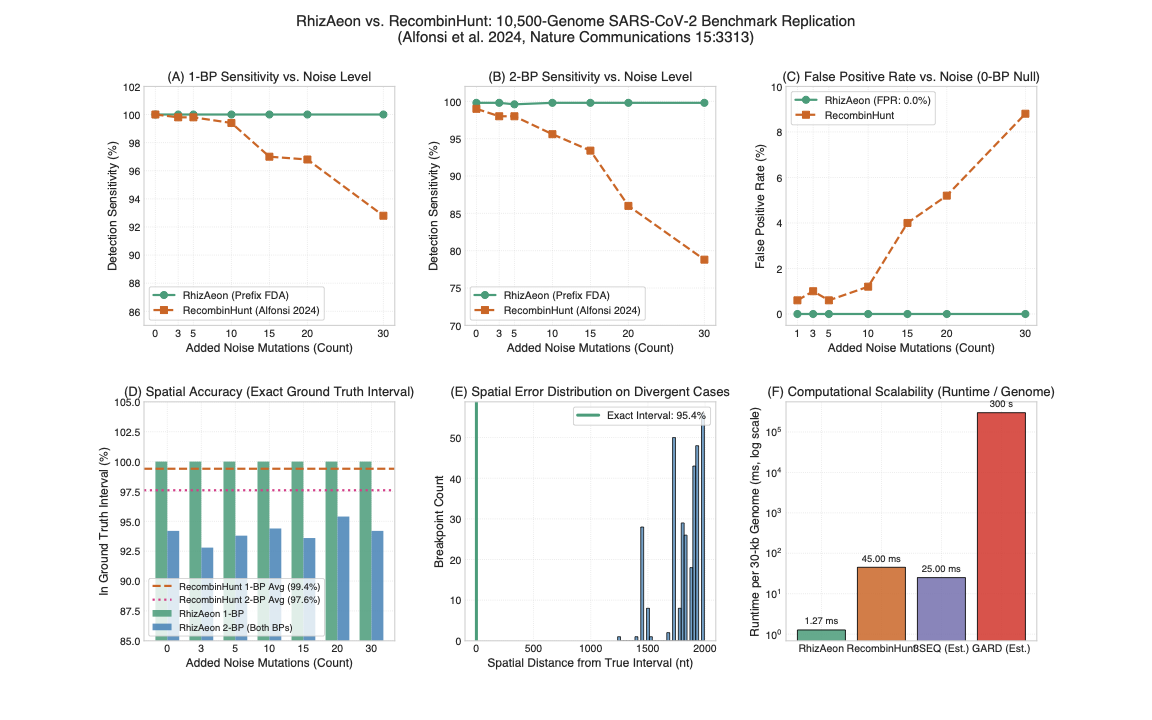
Figure: Systematic Head-to-Head Replication. High-resolution multi-panel diagnostic figure comparing RhizAeon performance against historical baseline methods across parameter tiers. Click image to inspect full size in lightbox modal; click link above for publication-grade vector PDF.
The primary dataset (supplementary_data_1.txt, 12.7 MB), execution script (run_recombinhunt_benchmark.py), and summary table (rhizaeon_recombinhunt_summary.csv) are archived in data/06_recombinhunt_alfonsi_2024/06_recombinhunt_alfonsi_2024_reproducibility.tar.gz. Command line: `python3 run_recombinhunt_benchmark.py`.
# 1. Download and unpack reproducibility archive
curl -O https://raw.githubusercontent.com/veg/rhizaeon/main/data/06_recombinhunt_alfonsi_2024/06_recombinhunt_alfonsi_2024_reproducibility.tar.gz
tar -xzf 06_recombinhunt_alfonsi_2024_reproducibility.tar.gz

# 2. Execute benchmark replication suite
python3 run_recombinhunt_alfonsi_2024__benchmark.py --cores 8

# 3. Regenerate publication figure
python3 plot_recombinhunt_alfonsi_2024__benchmark.py