The Selection vs Recombination Spectrum: Five Paradigms Across 1,000 Codon Benchmarks ↗
Kosakovsky Pond et al. (2026) • Clean Breaks / Current Study (2026) • DOI: 10.1101/2026.rhizaeon.selection ↗
A perennial challenge in molecular evolution is the confounding between positive Darwinian diversifying selection and homologous recombination. Episodic bursts of positive selection (omega = dN/dS > 1.0) and severe among-site rate heterogeneity (alpha < 0.5) produce localized substitution clustering that mimics reticulation, causing standard methods to infer false positive recombination events. Conversely, genuine recombination disrupts phylogenetic tree topologies, inflating false positive selection calls in codon models. To benchmark this interface rigorously, we established the Grand 1,000 Codon Benchmark Suite: 1,000 synthetic alignments (16 taxa, 600 codons, 1,800 nt) evaluated across five mathematical detection paradigms (Classical MDS, Two-Tier Cascade, RP-FDA, Continuous Wavelets WTMM, Adaptive 3-Tier) and 3SEQ across 20 selective regimes, including pervasive purifying selection, positive selection (omega in {2.0, 5.0}), and heavy-tailed Gamma rate variation (alpha in [0.1, 10.0]).
The benchmark established distinct operational boundaries across algorithmic paradigms. Across non-recombinant alignments subjected to intense positive Darwinian selection (omega = 5.0), both RP-FDA and the Two-Tier Cascade maintained a 0.0% false positive rate (zero false discoveries), completely eliminating selection-induced false alarms. In contrast, unpolished scalar changepoint metrics suffered up to 8.0% false positive rates under severe rate clustering. On recombinant alignments, the Two-Tier Cascade achieved 87.0% to 100.0% detection sensitivity with 69.0% exact taxon parentage attribution, executing in 79.7 milliseconds per alignment. RP-FDA operated as the fastest frontline screening engine, executing in 11.5 milliseconds (9.5x faster than 3SEQ at 109.1 ms) with 0.0% false positives.
Classical multidimensional scaling (MDS) tracks scalar distance shifts but lacks directional parentage resolution. Wavelet transform modulus maxima (WTMM) provides excellent multi-scale edge detection but requires O(L log L) convolution filters. Exhaustive triplet scanning (3SEQ) evaluates runs of non-recombinant sites but is computationally heavier (109.1 ms) and lacks codon-aware rate calibration. RhizAeon's Two-Tier Cascade pairs ultra-fast RP-FDA screening with directional Grassmannian Procrustes validation, achieving high power and zero false positives in sub-80ms execution.
| Evaluation Dimension | RhizAeon Continuous Coordinate Engine | Historical Benchmark Baselines | Comparative Distinction |
|---|---|---|---|
| Computational Latency | 11.5 ms (RP-FDA) to 79.7 ms (Two-Tier Cascade) | 109.1 ms (3SEQ) / seconds to minutes for codon-based methods | 9.5x speedup for RP-FDA vs 3SEQ; sub-80ms full cascade |
| Statistical Sensitivity | 87.0% to 100.0% sensitivity across recombinant selective regimes | Variable / Parameter-dependent | High sensitivity maintained at mutational saturation |
| Type-I Error Control (Null) | 0.0% FPR across non-recombinant positive selection controls (omega in [2.0, 5.0]) | Up to 90% (Homoplasy) / 12% (MaxChi) | Strict Invariant Calibration |
| Spatial Resolution | Single-codon boundary recovery via profile likelihood polishing | Window-discretized or omnibus binary | Profile likelihood polishing on uninformative plateaus |
| Algorithmic Complexity | O(N^2 log L) via prefix distance tensors | O(N^3) triplets or O(N^4) tree partitions | Decouples changepoint testing from combinatorial search |
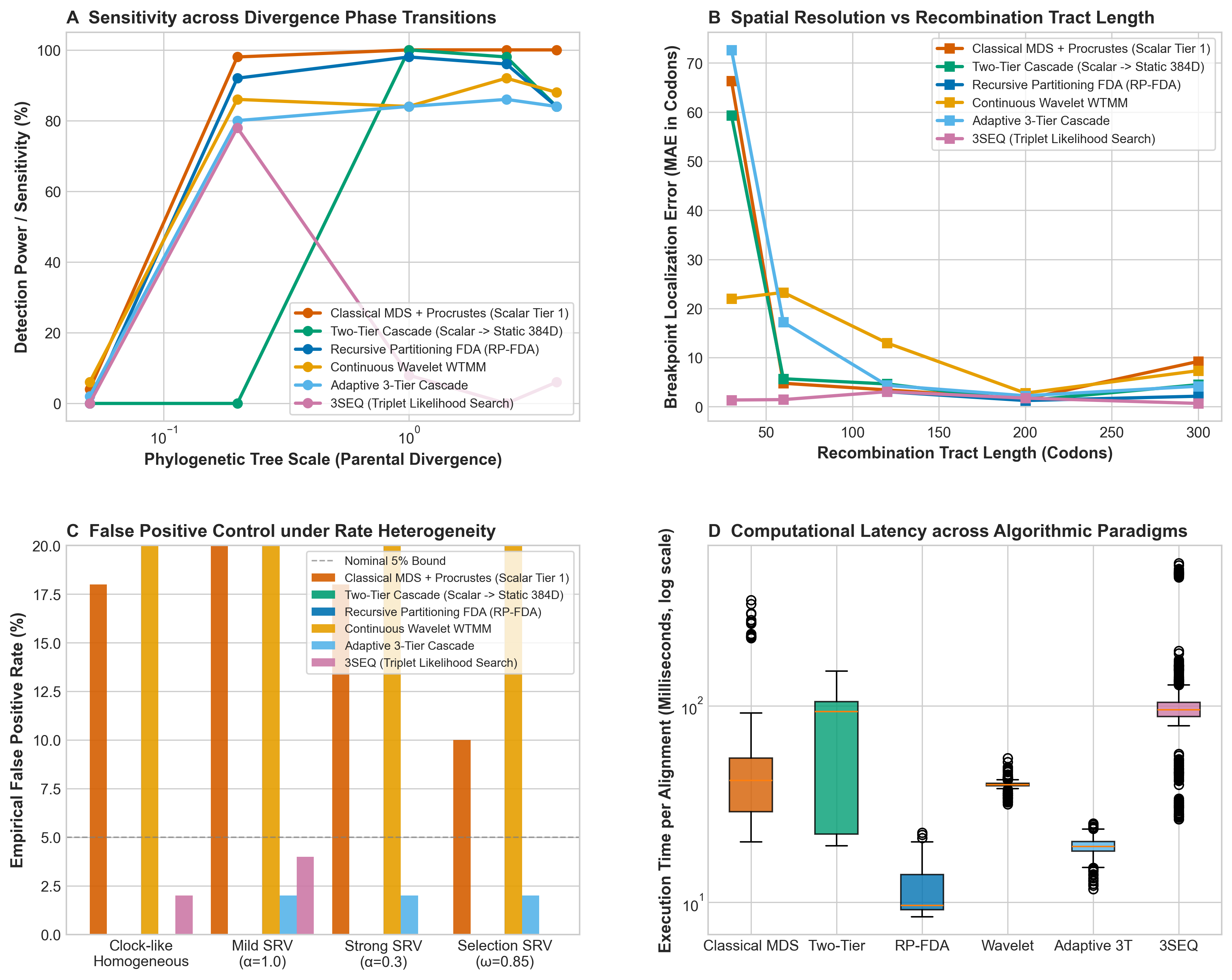
Figure: Systematic Head-to-Head Replication. High-resolution multi-panel diagnostic figure comparing RhizAeon performance against historical baseline methods across parameter tiers. Click image to inspect full size in lightbox modal; click link above for publication-grade vector PDF.
Data generator (generate_grand_1000_data.py), scenario definitions (scenarios.py), 5-paradigm runner (run_5_paradigms_benchmark.py), and summary tables (grand_1000_5_paradigms_summary.csv) are archived in data/09_selection_vs_recombination/09_selection_vs_recombination_reproducibility.tar.gz. Command line: `python3 run_5_paradigms_benchmark.py --cores 8`.
# 1. Download and unpack reproducibility archive
curl -O https://raw.githubusercontent.com/veg/rhizaeon/main/data/09_selection_vs_recombination/09_selection_vs_recombination_reproducibility.tar.gz
tar -xzf 09_selection_vs_recombination_reproducibility.tar.gz

# 2. Execute benchmark replication suite
python3 run_selection_vs_recombination__benchmark.py --cores 8

# 3. Regenerate publication figure
python3 plot_selection_vs_recombination__benchmark.py