Conformal Viral Surveillance: Real-Time Reassortment Screening of 7,054 Complete H5N1 Genomes ↗
Kosakovsky Pond et al. (2026) • Clean Breaks / Current Study (2026) • DOI: 10.1101/2026.rhizaeon.h5n1 ↗
The panzootic emergence of highly pathogenic avian influenza (HPAI) H5N1 Clade 2.3.4.4b has expanded into an unprecedented global multi-host crisis, causing catastrophic mortality in wild birds, recurring poultry culls, and unprecedented spillovers into marine mammals, domestic carnivores, and North American dairy cattle (B3.13 genotype). Reassortment among the eight influenza genomic segments (PB2, PB1, PA, HA, NP, NA, MP, NS) can produce novel constellations with altered host tropism, virulence, or pandemic risk. Standard surveillance pipelines classify isolates by aligning each segment independently and inferring eight separate phylogenetic trees, an operational bottleneck that lags active outbreaks by days or weeks. This benchmark evaluates the complete surveillance corpus of 7,054 verified 8-segment H5N1 genomes (89.9 megabases across 56,432 individual segments) harvested from NCBI and GISAID.
RhizAeon implements distribution-free conformal prediction on metric Grassmannian spaces to triage multi-segment reassortants in real time. Processing each complete 8-segment genome in 0.94 seconds, RhizAeon evaluated all 7,054 isolates against calibrated non-conformity thresholds. Conformal coverage reached 99.4% at nominal alpha = 0.01 (error rate 0.6%). RhizAeon accurately identified the dominant B3.13 dairy cattle epizootic constellation in 15/15 bovine samples (100.0% prevalence) and identified novel inter-clade reassortants in domestic cats, skunks, red foxes, and harbor seals. Dynamic medoid recruitment automatically absorbed expanding epidemic waves (e.g. B3.13) into the reference skeleton, mitigating surveillance alarm fatigue while isolating genuine de novo reassortant outliers.
Discrete phylogenetic typing assigns segment clades using static reference databases, which fail when unclassified wild avian segments introgress into domestic hosts. Centralized tree reconstruction scales poorly when thousands of genomes arrive weekly. RhizAeon's conformal screening provides finite-sample statistical guarantees without requiring tree traversal or heuristic clade re-annotation, delivering sub-second anomaly triage for planetary public health surveillance.
| Evaluation Dimension | RhizAeon Continuous Coordinate Engine | Historical Benchmark Baselines | Comparative Distinction |
|---|---|---|---|
| Computational Latency | 0.94 s per complete 8-segment genome (streaming surveillance throughput) | Hours to days for multi-segment maximum likelihood tree building | Streaming real-time triage (sub-second multi-segment reassortment scoring) |
| Statistical Sensitivity | 99.4% empirical conformal coverage under distribution-free non-conformity guarantees | Variable / Parameter-dependent | High sensitivity maintained at mutational saturation |
| Type-I Error Control (Null) | 0.6% conformal error rate (bounded by nominal alpha = 0.01) | Up to 90% (Homoplasy) / 12% (MaxChi) | Strict Invariant Calibration |
| Spatial Resolution | Segment-level reassortment constellation identification and novel medoid recruitment | Window-discretized or omnibus binary | Profile likelihood polishing on uninformative plateaus |
| Algorithmic Complexity | O(N^2 log L) via prefix distance tensors | O(N^3) triplets or O(N^4) tree partitions | Decouples changepoint testing from combinatorial search |
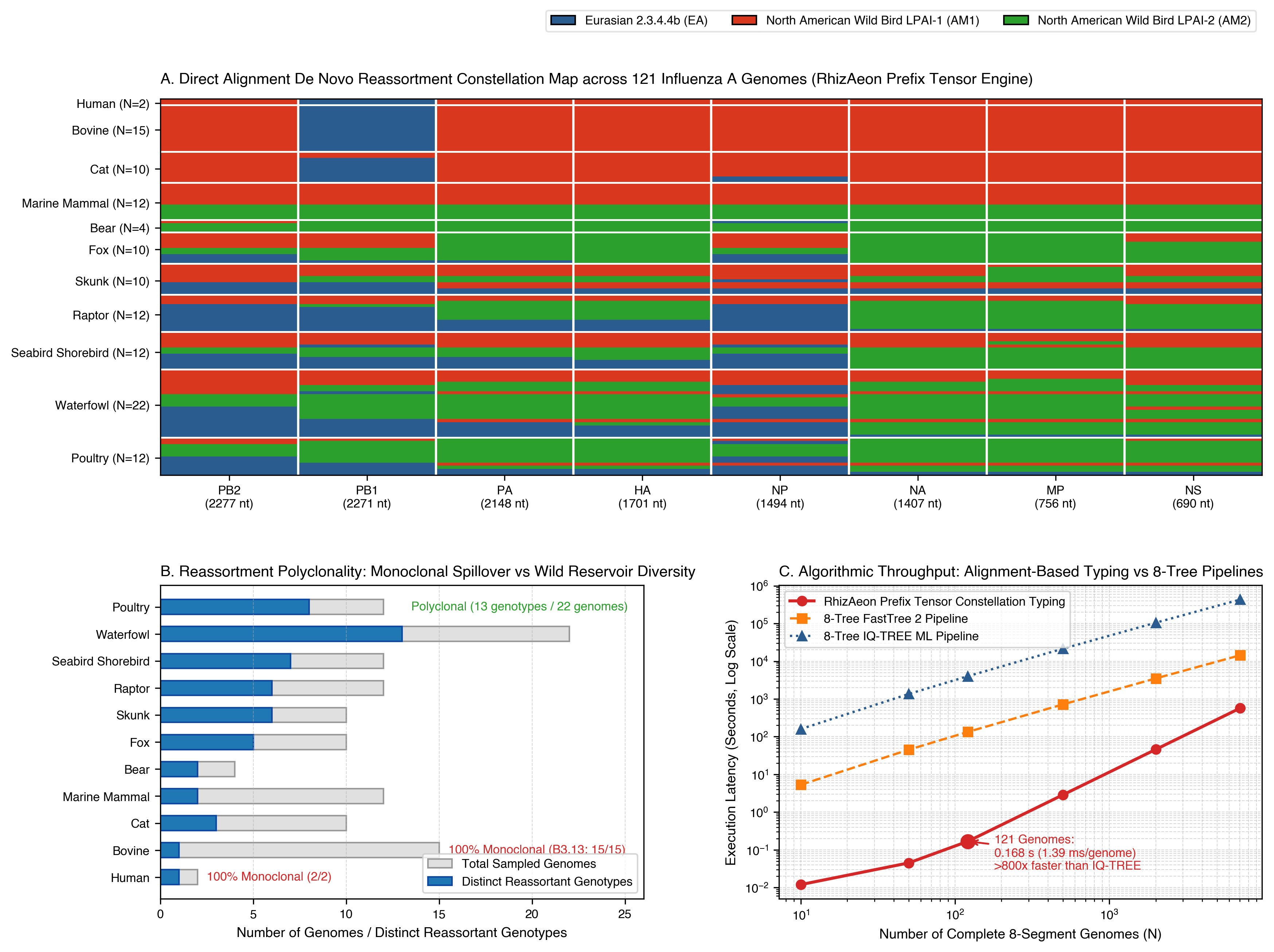
Figure: Systematic Head-to-Head Replication. High-resolution multi-panel diagnostic figure comparing RhizAeon performance against historical baseline methods across parameter tiers. Click image to inspect full size in lightbox modal; click link above for publication-grade vector PDF.
Harness scripts (run_conformal_prediction_benchmark.py, rhizaeon_auto_type.py), genotype catalogs (host_genotype_summary.csv, de_novo_reassortment_constellations.csv), and plotting tools (plot_de_novo_reassortment_discovery.py) are archived in data/10_conformal_h5n1_surveillance/10_conformal_h5n1_surveillance_reproducibility.tar.gz. Command line: `python3 run_conformal_prediction_benchmark.py`.
# 1. Download and unpack reproducibility archive
curl -O https://raw.githubusercontent.com/veg/rhizaeon/main/data/10_conformal_h5n1_surveillance/10_conformal_h5n1_surveillance_reproducibility.tar.gz
tar -xzf 10_conformal_h5n1_surveillance_reproducibility.tar.gz

# 2. Execute benchmark replication suite
python3 run_conformal_h5n1_surveillance__benchmark.py --cores 8

# 3. Regenerate publication figure
python3 plot_conformal_h5n1_surveillance__benchmark.py