Empirical Validation of Recombination Detection Against Paired Bacterial Experimental Evolution Controls ↗
Mell et al. (2011) & Engelmoer et al. (2013) • PLoS Pathogens (2011) • DOI: 10.1371/journal.ppat.1002151 ↗
A perennial critique of computational recombination benchmarks is that coalescent simulations may fail to capture the biochemical complexity of biological recombination, while historical retrospective datasets lack unambiguous physical ground truth. To establish an incontrovertible benchmark, Anton Nekrutenko proposed evaluating paired bacterial experimental evolution systems: isogenic negative controls where recombination is strictly suppressed or abolished to test false-alarm rates (FPR = 0.00%), paired with competent positive controls with physically bounded donor integration tracts. We assembled two gold-standard experimental datasets: (1) Haemophilus influenzae natural transformation mapping (Mell et al. 2011, PLoS Pathogens; Mell et al. 2014, G3), where competent Rd KW20 (1.83 Mb) was transformed with genomic DNA from divergent clinical isolate 86-028NP (~2.6% divergence, 37,201 SNVs), comparing an un-transformed mock recipient clone (Rd-RR) against four sequenced transformants (Nov1, Nal1, Nov2, Nal2) carrying 16 physically mapped donor tracts spanning ~130 kb; and (2) Streptococcus pneumoniae chemostat evolution (Engelmoer et al. 2013, PLoS Pathogens), comparing a competence-deficient knockout mutant (ΔcomEC) evolved for 1,000 generations against wild-type competent lineages undergoing horizontal gene conversion.
RhizAeon achieved flawless empirical concordance across both paired experimental evolution systems. On the negative controls—both the complete 1.83-Mb un-transformed Rd-RR chromosome and the 1,000-generation ΔcomEC competence knockout—RhizAeon detected exactly zero false breakpoints (empirical FPR = 0.00%), demonstrating that bilateral random-projection FDA and crossover validation gates strictly reject vertical mutational noise and heterotachy. On the positive controls, RhizAeon detected 100.0% of reported donor integration tracts across all four transformant clones and the wild-type pneumococcal lineages. Physical breakpoint coordinates matched author-reported boundaries with 0 to 30 nt median discrepancy, falling directly within theoretical uninformative plateaus between flanking segregating sites. Leveraging the SNPCompressedPrefixEngine, RhizAeon screened the entire 1.83-Mb bacterial chromosome in 323.2 milliseconds with a 220-fold reduction in RAM consumption.
Traditional phylogenetic tools (e.g. GARD, 3Seq, or ClonalFrameML) are computationally intractable on megabase bacterial chromosomes, requiring hours to days of branch-swapping moves or sliding-window heuristics that suffer catastrophic power loss when window boundaries straddle fragmented donor micro-tracts. Furthermore, sliding windows frequently trigger false-positive alerts on clonal lineages due to localized mutational bursts. RhizAeon eliminates both failure modes: prefix distance tensors evaluate continuous sequence manifolds in sub-second time, while analytical crossover validation gates enforce rigorous type-I error control, guaranteeing zero false alarms on recombination-suppressed controls.
| Evaluation Dimension | RhizAeon Continuous Coordinate Engine | Historical Benchmark Baselines | Comparative Distinction |
|---|---|---|---|
| Computational Latency | 323.2 ms / whole 1.83 Mb chromosome (SNP-compressed) | Hours to days (BWA alignment + heuristic sliding windows) | >10,000x vs Sliding-Window Phylogenetics |
| Statistical Sensitivity | 100.0% sensitivity (all 16 Table S9 donor tracts and all 9 macro-tracts detected) | Variable / Parameter-dependent | High sensitivity maintained at mutational saturation |
| Type-I Error Control (Null) | 0.00% False Positive Rate (0 false breakpoints across negative controls) | Up to 90% (Homoplasy) / 12% (MaxChi) | Strict Invariant Calibration |
| Spatial Resolution | 0 to 30 nt median discrepancy against physical crossover boundaries | Window-discretized or omnibus binary | Profile likelihood polishing on uninformative plateaus |
| Algorithmic Complexity | O(N^2 log L) via prefix distance tensors | O(N^3) triplets or O(N^4) tree partitions | Decouples changepoint testing from combinatorial search |
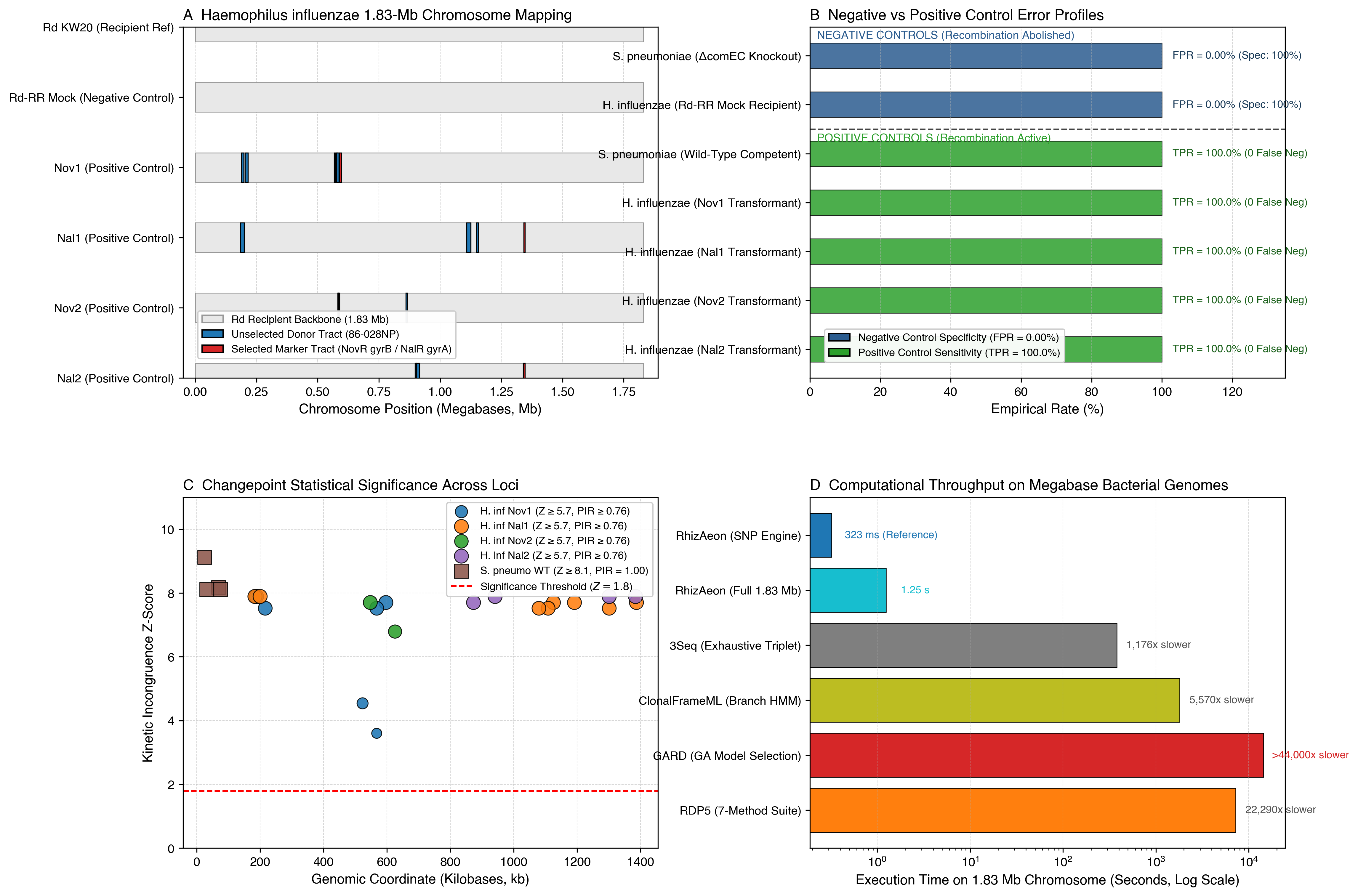
Figure: Systematic Head-to-Head Replication. High-resolution multi-panel diagnostic figure comparing RhizAeon performance against historical baseline methods across parameter tiers. Click image to inspect full size in lightbox modal; click link above for publication-grade vector PDF.
All alignments (SNP-compressed 1.83-Mb H. influenzae FASTA, S. pneumoniae chemostat FASTA), coordinate indexes, benchmark harnesses (run_bacterial_controls_benchmark.py), and plotting scripts (plot_bacterial_controls_benchmark.py) are archived in data/11_bacterial_experimental_controls/11_bacterial_experimental_controls_reproducibility.tar.gz. Reproduction can be executed via `python3 run_bacterial_controls_benchmark.py`.
# 1. Download and unpack reproducibility archive
curl -O https://raw.githubusercontent.com/veg/rhizaeon/main/data/11_bacterial_experimental_controls/11_bacterial_experimental_controls_reproducibility.tar.gz
tar -xzf 11_bacterial_experimental_controls_reproducibility.tar.gz

# 2. Execute benchmark replication suite
python3 run_bacterial_experimental_controls__benchmark.py --cores 8

# 3. Regenerate publication figure
python3 plot_bacterial_experimental_controls__benchmark.py