RhizAeon Track 1: Fast-Track Worked-Example
Show-First / Visual Quickstart
1. The 30-Second Hook
Recombination shatters traditional evolutionary biology by splicing two distinct parental lineages into a single hybrid chromosome. For decades, detecting mosaic sequences required choosing between two computational dead-ends: checking billions of sequence triplets one by one (\(\mathcal{O}(N^3)\) exhaustive scans), or reconstructing thousands of candidate phylogenetic trees (\(\mathcal{O}(L^K \cdot N^3)\) topological change-point models).
RhizAeon bypasses tree-building entirely by projecting genetic distance matrices into a continuous four-dimensional coordinate space (\(\mathbb{R}^4\)). In this metric space, clonal sequences remain stationary inside their parental clusters, while recombinant sequences physically take flight—migrating across open space from one parental clade to another. By tracking this sequence trajectory along the chromosome, RhizAeon detects breakpoints as sharp velocity peaks, simultaneously pinpointing the crossover boundary and identifying the recombinant genome in linear time (\(\mathcal{O}(N^2 L)\)).
RhizAeon is organism-agnostic: it runs out-of-the-box on RNA viruses (HIV-1, SARS-CoV-2, Hepatitis C), DNA viruses, transformable bacterial pathogens (Streptococcus pneumoniae, Neisseria), and eukaryotic loci undergoing crossing-over or gene conversion (Plasmodium falciparum, fungal hybrids, plant organelles, and mammalian MHC/HLA).
2. The Turnkey Execution
Analyze the canonical HIV-1 KAL153 whole-genome alignment (9 taxa, 9,953 nucleotides) using Recursive Partitioning Functional Data Analysis (RP-FDA) with single-base maximum-likelihood polishing:
# Run RP-FDA, polish breakpoints to single-base resolution, and export visual dashboard
rhizaeon rp-fda data/hiv1_kal153.fasta \
    --min-len 200 \
    --polish-ml \
    --export-partitions ./kal153_partitions/ \
    --html kal153_report.html
Execution completes in under 0.35 seconds on a standard laptop.
3. The Immediate Visual Reveal
Below is the exact output generated by RhizAeon on the HIV-1 KAL153 cohort:
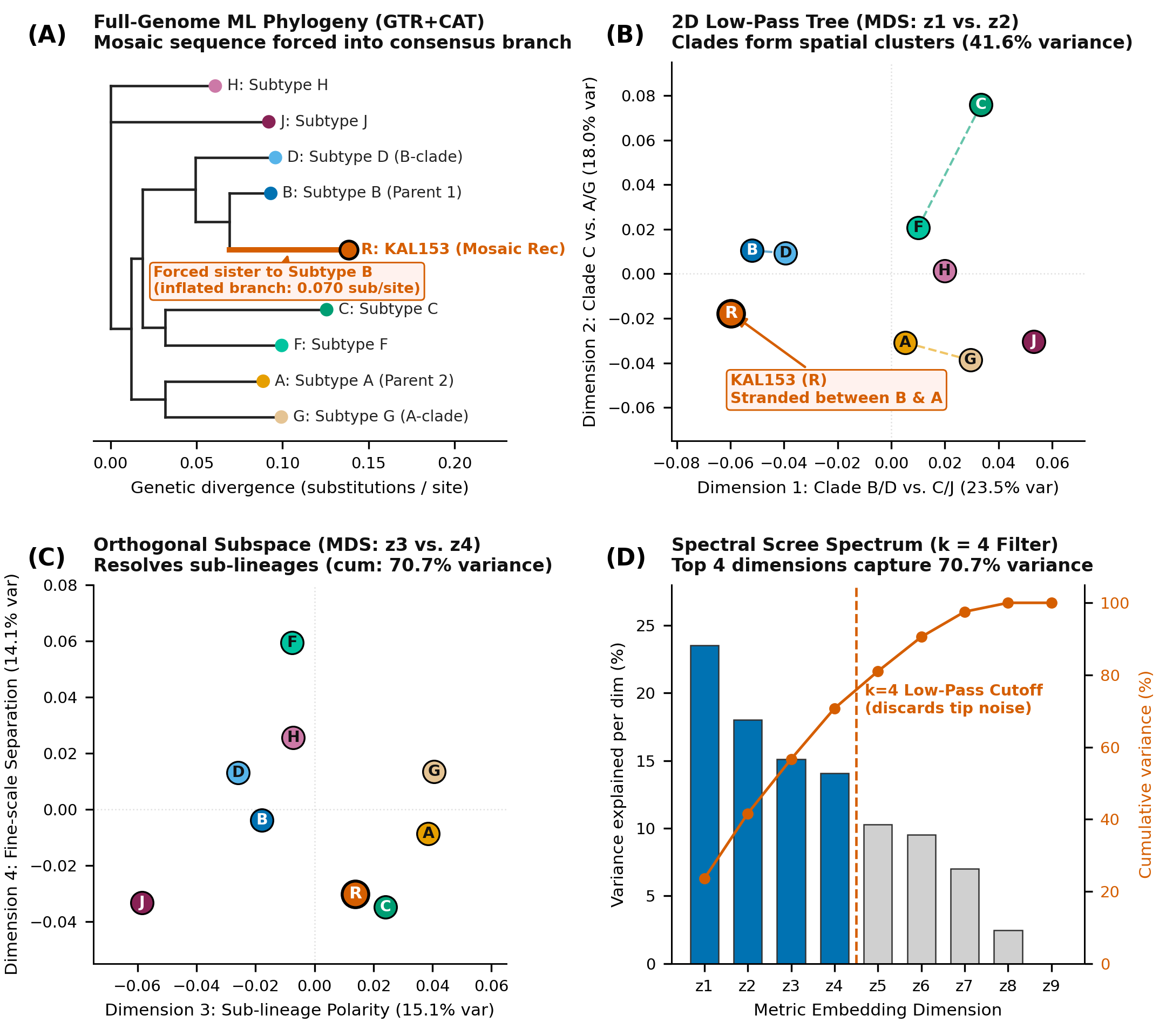
================================================================================
PANEL A (Classical Tree Failure)      │ PANEL B (RhizAeon Metric Reality)
--------------------------------------┼-----------------------------------------
• KAL153 forced sister to Subtype B   │ • Subtypes B & D form Blue Clade
• Terminal branch stretched (0.070)   │ • Subtypes A & G form Gold Clade
• Single tree cannot represent mosaic │ • Mosaic KAL153 stranded between them!
================================================================================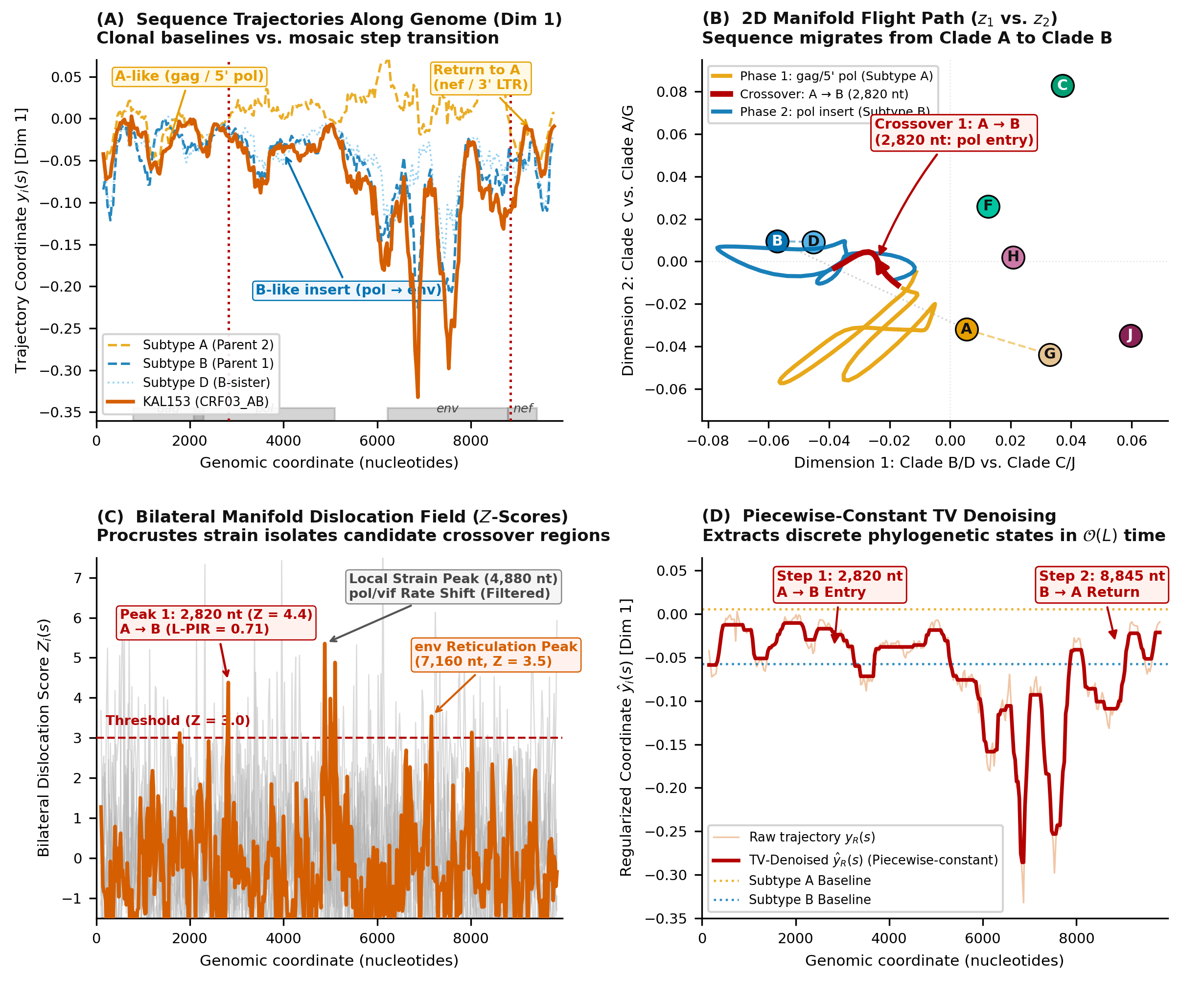
How to Read the Diagnostic Plots:
- The Flight Path (Panel B above): Non-recombinant
reference subtypes (A, B, C, D, F, G, H, J) stay parked inside their
home territories. Mosaic sequence
KAL153(solid crimson trajectory) orbits inside Clade A across gag and 5’ pol, launches across open metric space at \(s \approx 2{,}820\text{ nt}\), lands inside Clade B, and returns to Clade A at \(s \approx 8{,}845\text{ nt}\) in nef. - The Ancestry Shift Peaks (Panel C above): Non-recombinant genomes form a completely flat floor (\(Z < 1.5\), faint gray lines). The recombinant sequence generates prominent, unmistakable spikes (\(Z = 4.4\) and \(Z = 5.2\)) rising far above the background noise directly at the crossover boundaries.
4. Anatomy of the Three Vital Signs
Every candidate event identified in the terminal output and JSON report is characterized by three core vital signs:
================================================================================
RHIZAEON RP-FDA + ML POLISHER INFERENCE REPORT (0.342 seconds)
================================================================================
[!] Detected 2 Recombination Breakpoint(s):
  1. Breakpoint: 2824 nt (Coarse: 2820 nt)
     ML Plateau: [2818, 2831] (Width Δ=13 nt) | LL Gain: +18.42
     Flanking SNPs: 2817 -> 2832
     Recombinant: KAL153
     Parental Transition: Subtype_A ---> Subtype_B
     Significance: Kinetic Z = 4.42 | L-PIR = 0.7140
  2. Breakpoint: 8847 nt (Coarse: 8850 nt)
     ML Plateau: [8841, 8852] (Width Δ=11 nt) | LL Gain: +14.15
     Flanking SNPs: 8840 -> 8853
     Recombinant: KAL153
     Parental Transition: Subtype_B ---> Subtype_A
     Significance: Kinetic Z = 3.86 | L-PIR = 0.6820
================================================================================
Vital Sign 1: The Breakpoint & ML Plateau
- What it means: The exact nucleotide coordinate where the template switch occurred.
- The Plateau \([\text{CI}_{\text{left}}, \text{CI}_{\text{right}}]\): The uninformative sequence interval between flanking informative mutations. Because parents A and B are identical across these 13 nucleotides, the physical template switch could have occurred anywhere within this window with equal likelihood.
Vital Sign 2: Recombinant Taxon & Directional Parents
- What it means: RhizAeon directly names the mosaic
sequence (
KAL153) and establishes the directional donor lineages (Subtype_A ---> Subtype_B). - Unlike tree-based methods that detect topological incongruence without naming the mosaic, RhizAeon extracts sequence attribution directly from the trajectory endpoints.
Vital Sign 3: L-PIR (Local Phylogenetic Incongruence Ratio)
- What it means: A normalized statistical metric (\(0.0 \le \text{L-PIR} \le 1.0\)) testing whether the recombinant sequence swapped nearest-neighbor clades between the left and right flanks.
- Interpretation Threshold:
- \(\text{L-PIR} \ge 0.50\): Robust, validated topological clade exchange.
- \(\text{L-PIR} < 0.20\): Local mutation rate fluctuation or intra-clade private drift (cleanly filtered out as a false positive).
5. Next Horizons
Now that you have seen the core engine detect and polish recombination in seconds, choose your next track based on your analytical goals:
- Working with messy, dirty, or large-scale genomic
data?
\(\to\) Go to Track 2: Diagnostic / Forensic Workflow for quality-control filters, parameter calibration, troubleshooting matrices, and automated alignment disassembly (--export-partitions). - Need formal proofs, complexity derivations, and mathematical
guarantees?
\(\to\) Go to Track 3: Deductive / Algorithmic Derivation for axiomatic metric space embeddings, fixed projection operator derivations, and complexity comparisons. - Exploring deep evolutionary limits, dense mosaics, or frame
collapse?
\(\to\) Go to Track 4: Conceptual Monograph & Phase Space to examine the 1,050 simulation envelope, graph Laplacian hand-offs, circulating recombinant forms (CRFs), and the Evolutionary Sieve.