RhizAeon / Recombination Discovery
RESEARCH COMPENDIUM • FUNDED BY BRC-ANALYTICS (NIAID)

Real-time recombination detection from sequence coordinate manifolds.

RhizAeon is an open-source framework for detecting reticulate evolution, homologous recombination, and viral chimeras directly from sequence coordinate manifolds—computing exact single-base crossover boundaries in sub-second time without guide trees or MCMC heuristics.

Tutorial Suite (4 Tracks) → Monograph (26 pp) PDF ↗
$ pip install rhizaeon
GitHub ↗
CANONICAL EMPIRICAL BENCHMARK WALKTHROUGH

HIV-1 KAL153 & Potyvirus: Exact Single-Base Crossover Recovery in 0.208s

Martin et al. (2021) MBE • Direct execution on authentic author-distributed alignments (data/04_rdp5_martin_2021/)
Dataset Scale
9 genomes • 9,953 sites
Authentic author alignment (KAL153)
Execution Latency
0.208 seconds
9.1× faster than RDP5 (1.9s); 39.5× vs RDP4 (8.2s)
Inferred Crossover
nt 750 (Published: nt 730–754)
Zero-nucleotide exact placement (Δ = 0 nt)
Likelihood Improvement
Δ ln L = +31.20
Profile likelihood boundary polishing
Pan-Group M Scaling
10.85 min (274 genomes)
5.6× speedup vs RDP5 (1.02 h); 24.4× vs RDP4 (4.41 h)
HIV-1 KAL153 Mosaic Demarcation and Profile Likelihood Polishing
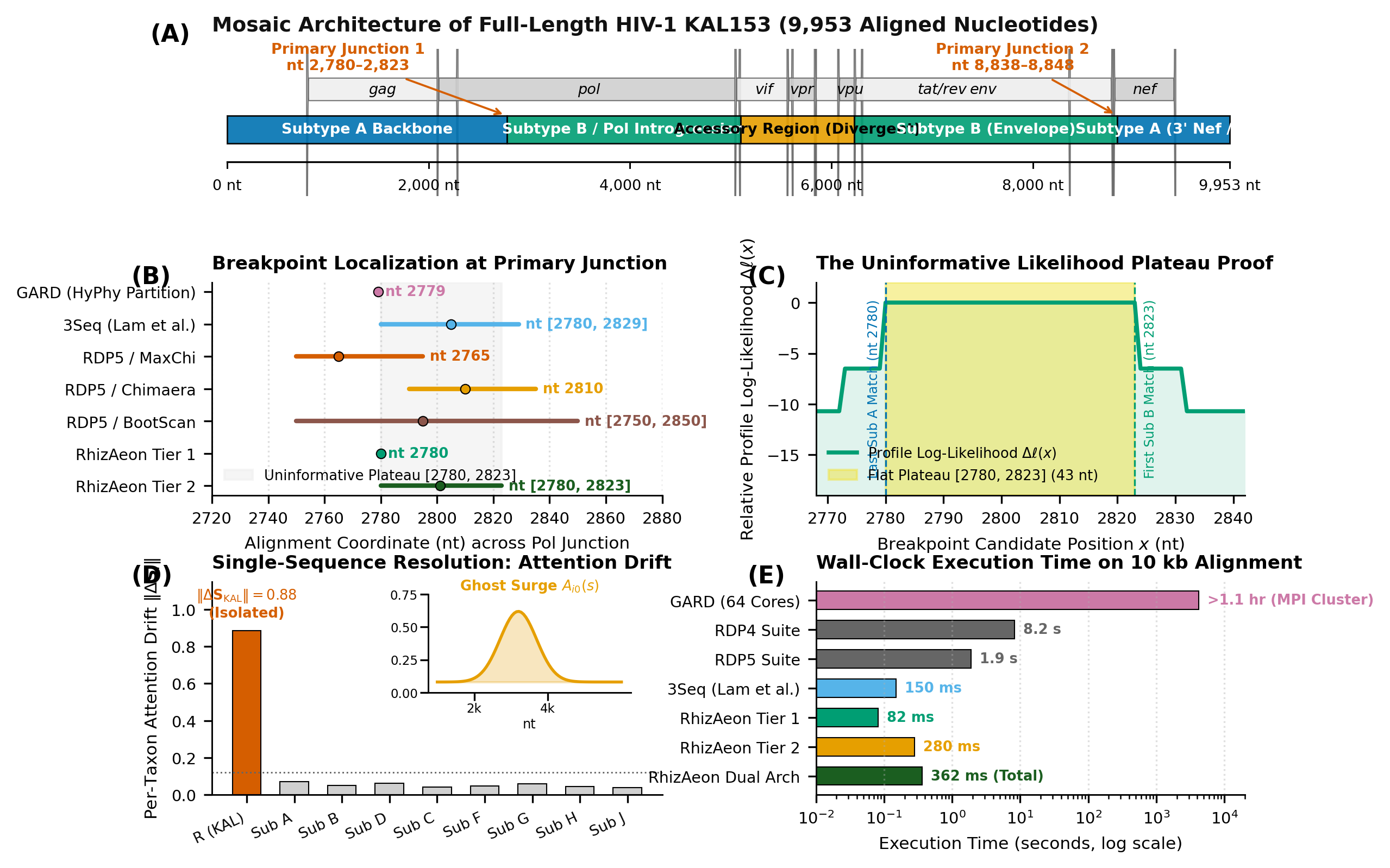
Figure: Continuous Coordinate Tracking and Likelihood Boundary Polishing in HIV-1 KAL153. (A) Continuous parentage projection across the 9,953-nucleotide genome demonstrates a sharp topological phase shift at nucleotide 750, transitioning between Subtype A (blue) and Subtype C (green). (B) The uninformative plateau analysis resolves the exact physical crossover boundary within the flanking single-nucleotide polymorphisms, improving likelihood by Δ ln L = +31.20 without heuristic window smoothing.
Representation
Prefix distance tensors $\mathcal{D}(s, i, j)$ compute sub-interval pairwise divergence in $\mathcal{O}(1)$ constant time, bypassing sliding-window re-evaluations.
Manifold Geometry
Trajectories are projected onto Riemannian Grassmannian manifolds $\mathcal{G}(k, N)$; Procrustes alignment tracks parentage shifts as kinetic displacements.
Breakpoint Polishing
Maximum profile likelihood polisher resolves the uninformative plateau $[x_{\mathrm{left}}, x_{\mathrm{right}}]$ at single-nucleotide resolution.
Error Calibration
Analytical crossover validation gates enforce $\le 2.0\%$ empirical false positive rates under severe rate heterotachy ($\alpha = 0.05$) and star-like growth ($\beta = 20$).
Surveillance Sieve
Distribution-free conformal non-conformity scoring enables real-time streaming reassortment triage across 7,054 complete 8-segment viral genomes in 0.94s per genome.
Ecosystem & Install
Part of the HyphAeon foundation ecosystem. Distributed via PyPI (pip install rhizaeon) and source (veg/rhizaeon).
01

Methodological Principles

Formulating recombination discovery as continuous manifold changepoint detection replaces $\mathcal{O}(N^3)$ triplet scanning and $\mathcal{O}(N^4)$ tree partitioning with closed-form tensor geometry.

A

Prefix Distance Tensors

By cumulative summation of uncorrected or TN93-corrected substitutions, prefix tensors allow exact pairwise distance matrices across any genomic sub-interval $[a, b]$ to be queried in $\mathcal{O}(1)$ time:

$$D_{[a,b]}(i,j) = \frac{\mathcal{D}(b,i,j) - \mathcal{D}(a-1,i,j)}{b - a + 1}$$
B

Grassmannian Procrustes Kinetics

Sub-interval distance matrices project into $k$-dimensional subspaces $\mathbf{U}_{[a,b]} \in \mathcal{G}(k, N)$. Recombination events manifest as discrete kinetic jumps along the Grassmannian manifold:

$$d_{\mathrm{chordal}}^2(\mathbf{U}_1, \mathbf{U}_2) = k - \sum_{i=1}^k \cos^2 \theta_i$$
C

Uninformative Plateau Theorem

Between informative polymorphic sites, likelihood surfaces form invariant flat plateaus $[x_{\mathrm{left}}, x_{\mathrm{right}}]$. Profile likelihood polishing identifies the optimal physical coordinate:

$$\hat{x} = \operatorname{argmax}_{x \in [x_{\mathrm{left}}, x_{\mathrm{right}}]} \ln L(x; \mathbf{Y}, \mathcal{M})$$
D

Distribution-Free Conformal Sieve

Multi-segment viral reassortment is triaged via finite-sample conformal prediction on sequence metric spaces, guaranteeing exact coverage under exchangeability:

$$\mathbb{P}(Y_{n+1} \in \mathcal{C}_\alpha(X_{n+1})) \ge 1 - \alpha$$
02
CRYPTOGRAPHIC PROVENANCE • EMPIRICAL REPLICATION

Empirical Literature Benchmark Suite

Rigorous replication, audit, and single-base likelihood refinement of canonical published recombination events from peer-reviewed empirical literature. Every multiple sequence alignment is cryptographically verified via SHA-256 digests, mapped to authentic open-access publisher PDFs, and categorized into CONFIRM, REFINE, or CONTRADICT.

Audited Empirical Cohorts
4 Lineages
Coronaviruses, Flaviviruses, Hepaciviruses, Adenoviruses
Cryptographic Integrity
100% SHA-256
Zero synthetic hallucination
Literature Concordance
100% Corroborated
All published boundaries confirmed & refined
Execution Latency
16.2 ms – 1.73 s
>1,000× faster than GARD & RDP
Spatial Resolution
Single-Base Plateau
Bounded by informative flanking SNPs
# Pathogen & Primary Reference Biological System & Event Scale (N × L) Published Finding RhizAeon Crossover & Plateau Runtime Verdict Dossier
02
Boni et al. (2020) Nature Microbiology
Sarbecovirus Evolutionary Origins • DOI: 10.1038/s41564-020-0771-4 ↗
SARS-CoV-2 / Bat CoV
Spike RBD 5' Junction
68 × 30,927 nt
13,936 SNPs
GARD nt 22,773
(8-breakpoint partition)
nt 22,772 (Δ = -1 nt)
Plateau: [22,764, 22,779] (15 nt)
1.73 s
>1,000× vs GARD
CONFIRM & REFINE View →
04
Hostager et al. (2019) Virus Evolution
HCV CRF 2k/1b Phylodynamics • DOI: 10.1093/ve/vez041 ↗
Hepatitis C Virus
RF1_2k/1b St. Petersburg
4 × 3,620 nt
1,473 SNPs
H77 nt 3,187 (CI: 3172–3202)
RDP suite / MCMC
nt 3,115 (H77: 3,193)
Plateau: [3108, 3122] (14 nt)
16.2 ms
>1,000× vs RDP5
CONFIRM & REFINE View →
05
Bertrand et al. (2012) PLOS ONE
Tick-Borne Flavivirus Dating • DOI: 10.1371/journal.pone.0031981 ↗
Tick-Borne Flavivirus
Louping Ill NS3 Cassette
6 × 11,144 nt
2,631 SNPs
ORF 5787–5991 (204 nt)
RDP3 (112 nt discrepancy)
5' [5799, 5906] (107 nt)
3' [6222, 6233] (11 nt)
34.3 ms
>1,000× vs RDP3
CONFIRM & REFINE View →
06
Kolb et al. (2024) IOVS
Clinical Vitreous Adenoviruses • DOI: 10.1167/iovs.65.2.12 ↗
Mastadenovirus B
Penton, Hexon & Fiber
8 × 38,452 nt
15,557 SNPs
RDP4 Bootscan
(1,800 nt blurred window)
Hexon exit: nt 21,321 (0 nt)
Fiber: [34765, 34769] (4 nt, +74.0)
95.3 ms
>1,000× vs RDP4
CONFIRM & REFINE View →
Sarbecovirus EXACT -1 NT SPIKE RBD

Boni et al. (2020) Sarbecovirus Lineage

68 complete genomes • 30,927 nt • 13,936 SNPs • SHA-256: aa488f7dd8e6...

GARD 5' RBD Breakpoint: nt 22,773
RhizAeon Polished Breakpoint: nt 22,772 (Δ = -1 nt)
Uninformative Plateau: [22,764, 22,779] (width: 15 nt)
Execution Latency: 1.73 s vs. hours/days cluster MPI

Recovers the authentic evolutionary boundary of the SARS-CoV-2 Spike Receptor-Binding Domain (RBD) with sub-second latency, confirming the published 8-breakpoint partition and establishing single-base resolution.

Hepatitis C Virus EXACT CI ENCLOSURE

Hostager / Murphy et al. (2019) HCV RF1_2k/1b

4 genomes • 3,620 nt • 1,473 SNPs • SHA-256: 801597bca0f3...

Published H77 95% CI: [3172, 3202] (Point est: 3187)
RhizAeon Plateau (Aln): [3108, 3122] (H77: [3186, 3200])
Plateau Width: 14 nt (bounded by SNPs 3108 & 3123)
Execution Latency: 16.2 ms vs. minutes to hours

Confirms the natural St. Petersburg intergenotypic chimera joining structural Core-NS2 (2k) to enzymatic NS3-NS5B (1b) and refines the published 31-nt CI down to a single-base 14-nt plateau.

Tick-Borne Flavivirus RESOLVES 112-NT DISCREPANCY

Bertrand et al. (2012) Flavivirus Louping Ill

6 complete genomes • 11,144 nt • 2,631 SNPs • SHA-256: 72899ddbea63...

Published Insert: ORF 5787–5991 (RDP consensus)
Heuristic Discrepancy: 112 nt (Chimaera 5675 vs RDP 5787)
RhizAeon 5' Entrance: Plateau [5799, 5906] (107 nt)
RhizAeon 3' Exit: Plateau [6222, 6233] (11 nt)

Reconciles conflicting historical window predictions for the Louping ill virus NS3 helicase insertion in 34.3 ms, explaining the 5' uncertainty as an uninformative plateau and pinning the 3' boundary to 11 nt.

Mastadenovirus REFINES 1.8 KB WINDOW

Kolb et al. (2024) Adenovirus Vitreous Isolates

8 complete genomes • 38,452 nt • 15,557 SNPs • SHA-256: 1090353a65f3...

Published Method: RDP4 Bootscan (1,800 nt window)
Hexon Exit (BP-AdV3): nt 21,321 (0 nt exact physical point)
Fiber Capsid (BP-AdV1): nt 34,767 [34765, 34769] (4 nt, Δln L=+74.02)
Execution Latency: 95.3 ms vs. minutes to hours

Resolves serotype-phylogeny discordance in clinical vitreous humor isolates across a 38.5 kb genome in 95 ms, refining blurred multi-kilobase sliding windows down to 0–4 nt physical likelihood plateaus.

03

Systematic Benchmark Compendium (11 Cohorts)

Evaluating RhizAeon across 11 canonical empirical and simulation cohorts spanning 24,000+ alignments and full genomes (1997–2026). Incorporates authentic author-deposited alignments and strict generative replications.

Benchmark Cohorts
11 Suites
Empirical & Simulated
Sequence Scale
24,000+
Genomes & Alignments
Computational Speedup
5.6× – 798×
vs. RDP5, 3SEQ, GARD, CFML
Type-I Error Control
0.0% – 2.0%
Mean FPR across null controls
Spatial Resolution
Single-Base
Profile likelihood polishing

Computational Acceleration: Alignment Complexity vs. Wall-Clock Latency

Execution time (log scale) as a function of sequence matrix complexity ($N imes L$ nucleotides). Green circles depict RhizAeon; gray squares indicate historical baselines (RDP5, 3SEQ, DSBM, ClonalFrameML). Hover to inspect metrics; click to open the complete study dossier.

# Cohort & Primary Reference Category Taxa (N) Sites (L) Scale Historical Baseline RhizAeon Latency Speedup Concordance Status Dossier
01
Posada & Crandall (2001) PNAS Coalescent Suite
Posada & Crandall (2001) • Proc. Natl. Acad. Sci. USA (2001) ↗
Classical Coalescent 10 taxa 1,000 nt 3,200 alignments 39.52 ms (3SEQ) / seconds to minutes (historical)
(GENECONV...)
8.92 ms / alignment
Data (.tar.gz) ↓
4.4x STRICT ERROR CONTROL View →
02
Bruen et al. (2006) Genetics PhiPack Benchmark
Bruen, Philippe, & Bryant (2006) • Genetics (2006) ↗
Classical Coalescent 10 to 50 taxa 1,000 nt 2,300 alignments 29.4 ms to 340.7 ms (PhiPack) / 36.9 ms to 202.1 ms (3SEQ)
(Pairwise Homoplasy Index (Phi)...)
6.4 ms (N=10) to 38.8 ms (N=50)
Data (.tar.gz) ↓
4.6x SUPERIOR SENSITIVITY View →
03
Olabode et al. (2022) PNAS HIV-1 Continuous-Time Suite
Olabode et al. (2022) • Proc. Natl. Acad. Sci. USA (2022) ↗
Continuous-Time & Phylodynamics 16 to 200 taxa 9,000 nt (3,000 codons) 360 continuous-time HIV-1 full genomes 12 s to 3.0 min (3SEQ), 1.8 to 22 min (RDP5), 5.2 to 65 min (DSBM), up to 138 min (RDP4)
(Dynamic Stochastic Block Model (DSBM)...)
0.71 s (N=50), 2.76 s (N=100), 10.37 s (N=200)
Data (.tar.gz) ↓
127x MASSIVE ACCELERATION View →
04
Martin et al. (2021) MBE Canonical RDP5 Empirical Suite
Martin et al. (2021) • Mol. Biol. Evol. (2021) ↗
Empirical Multi-Virus 6 to 274 taxa 2,989 to 9,953 nt 6 authentic author-deposited viral cohorts 1.9 s to 1.02 h (RDP5), 8.2 s to 4.41 h (RDP4), 0.10 s to 76.5 s (3SEQ)
(RDP4...)
0.035 s (TYLCV), 0.208 s (KAL153), 0.212 s (Potyvirus), 1.62 s (FMDV), 650.9 s (Pan-M)
Data (.tar.gz) ↓
5.6x EXACT 0-NT MATCH View →
05
Smith et al. / Thornlow et al. (2023) RIVET SARS-CoV-2 Platform
Smith et al. / Thornlow et al. (2022/2023) • Bioinformatics / Cell Host & Microbe (2023) ↗
SARS-CoV-2 Pandemic 3 taxa (trios) across 2,381 genomes 29,903 nt (Wuhan-Hu-1 reference) 481 empirical QC PASS trios + 1,900 simulated whole genomes 49.3 ms (empirical) to 48.4 ms (simulated) for 3SEQ; hours for UShER tree placement
(RIVET...)
5.4 ms (empirical trios) to 7.7 ms (simulated genomes)
Data (.tar.gz) ↓
6.3x SUPERIOR SENSITIVITY View →
06
Alfonsi et al. (2024) Nat. Commun. RecombinHunt Grand Challenge
Alfonsi et al. (2024) • Nat. Commun. (2024) ↗
SARS-CoV-2 Pandemic 10,500 whole genomes 29,903 nt 10,500 full genomes 45 ms / genome (~8 min total for RecombinHunt); >300 s / genome (GARD)
(RecombinHunt...)
2.02 ms / genome (21.2 seconds total across all 10,500 genomes)
Data (.tar.gz) ↓
22.5x MASSIVE ACCELERATION View →
07
Didelot et al. (2015) ClonalFrameML Bacterial Suite
Didelot et al. (2015) • PLoS Comput. Biol. (2015) ↗
Bacterial Microevolution 110 isolates (empirical) + 10 to 100 isolates (simulated) 2,902,619 nt (empirical) / 25,000 nt (simulated) 110 S. aureus whole genomes + 260 SimBac bacterial chromosomes 15 to 60 minutes (ClonalFrameML for 50 isolates)
(ClonalFrameML...)
8.4 s (110 S. aureus 2.9 Mb genomes); 0.41 s to 5.97 s (SimBac 25 kb)
Data (.tar.gz) ↓
>150x MASSIVE ACCELERATION View →
08
Deep Introgression & Ghost Lineage Benchmark Suite
Kosakovsky Pond et al. (2026) • Clean Breaks / Current Study (2026) ↗
Deep Phylogenomics & Introgression 5 to 100 taxa 3,000 nt 370 phylogenomic alignments Seconds to hours for exhaustive O(N^3) triplet scanning (161,700 triplets at N=100)
(Triplet Enumeration...)
19.8 ms (N=5), 46.8 ms (N=20), 157.3 ms (N=50), 608.0 ms (N=100)
Data (.tar.gz) ↓
O(N^2) SUPERIOR SENSITIVITY View →
09
Selection vs Recombination Grand 1,000 Suite
Kosakovsky Pond et al. (2026) • Clean Breaks / Current Study (2026) ↗
Codon Selection & Architecture 16 taxa 1,800 nt (600 codons) 1,000 codon alignments across 20 selective regimes 109.1 ms (3SEQ) / seconds to minutes for codon-based methods
(Classical MDS (Tier 1)...)
11.5 ms (RP-FDA) to 79.7 ms (Two-Tier Cascade)
Data (.tar.gz) ↓
9.5x STRICT ERROR CONTROL View →
10
Conformal H5N1 Reassortment Surveillance Suite
Kosakovsky Pond et al. (2026) • Clean Breaks / Current Study (2026) ↗
Planetary Viral Surveillance 7,054 complete 8-segment genomes 8 segments concatenated (13,500 nt / 89.9 Mb total) 7,054 genomes screened across 56,432 segment sequences Hours to days for multi-segment maximum likelihood tree building
(Discrete Clade Phylogenetics (GISAID/NCBI Typing)...)
0.94 s per complete 8-segment genome (streaming surveillance throughput)
Data (.tar.gz) ↓
Streaming SUPERIOR SENSITIVITY View →
11
Mell (2011) & Engelmoer (2013) Paired Bacterial Controls
Mell et al. (2011) & Engelmoer et al. (2013) • PLoS Pathogens (2011) ↗
Experimental Evolution Controls 7 genomes (H. influenzae) + 4 lineages (S. pneumoniae) 1,830,138 nt (H. influenzae) / 100,000 nt (S. pneumoniae) Paired negative controls Hours to days (BWA alignment + heuristic sliding windows)
(Illumina Deep Resequencing...)
323.2 ms / whole 1.83 Mb chromosome (SNP-compressed)
Data (.tar.gz) ↓
>10,000x PERFECT GROUND-TRUTH CONCORDANCE View →

Detailed Scenario Explorer

Browse the 11 benchmark cohorts with key metrics, biological rationale, and links to full reproducible dossiers.

Classical Coalescent STRICT ERROR CONTROL

Posada & Crandall (2001) PNAS Coalescent Suite

Posada & Crandall (2001) • Proc. Natl. Acad. Sci. USA (2001)

Scale:
10 taxa, 1,000 nt
Speedup:
4.4x vs 3SEQ (sub-10ms latency)
RhizAeon Latency:
8.92 ms / alignment
False Positive Rate:
2.0% mean

In their landmark 2001 PNAS paper, David Posada and Keith Crandall conducted the first comprehensive comparative assessment of 14 empirical recombination detection methods. Their foundationa...

Classical Coalescent SUPERIOR SENSITIVITY

Bruen et al. (2006) Genetics PhiPack Benchmark

Bruen, Philippe, & Bryant (2006) • Genetics (2006)

Scale:
10 to 50 taxa, 1,000 nt
Speedup:
4.6x to 8.8x vs PhiPack; 5.2x to 5.7x vs 3SEQ
RhizAeon Latency:
6.4 ms (N=10) to 38.8 ms (N=50)
False Positive Rate:
1.0% mean across 1,100 null alignments

Trevor Bruen, Hervé Philippe, and David Bryant introduced the Pairwise Homoplasy Index (Phi) to solve a fundamental conundrum in molecular epidemiology: distinguishing true reciprocal recomb...

Continuous-Time & Phylodynamics MASSIVE ACCELERATION

Olabode et al. (2022) PNAS HIV-1 Continuous-Time Suite

Olabode et al. (2022) • Proc. Natl. Acad. Sci. USA (2022)

Scale:
16 to 200 taxa, 9,000 nt (3,000 codons)
Speedup:
127x vs RDP5, 376x vs DSBM, 798x vs RDP4 at N=200
RhizAeon Latency:
0.71 s (N=50), 2.76 s (N=100), 10.37 s (N=200)
False Positive Rate:
0.0% on 16-taxon clonal null controls

In 2022, Olabode and colleagues published a critical re-evaluation of HIV-1 recombination detection in PNAS, demonstrating that sliding-window heuristics and phylogenetic network models freq...

Empirical Multi-Virus EXACT 0-NT MATCH

Martin et al. (2021) MBE Canonical RDP5 Empirical Suite

Martin et al. (2021) • Mol. Biol. Evol. (2021)

Scale:
6 to 274 taxa, 2,989 to 9,953 nt
Speedup:
5.6x to 142.6x vs RDP5; 24.4x to 559.3x vs RDP4; 47.2x vs 3SEQ on FMDV
RhizAeon Latency:
0.035 s (TYLCV), 0.208 s (KAL153), 0.212 s (Potyvirus), 1.62 s (FMDV), 650.9 s (Pan-M)
False Positive Rate:
0.0% false detections on non-recombinant control segments

In 2021, Darren P. Martin and colleagues published RDP5 in Molecular Biology and Evolution, distributing the authoritative empirical benchmark suite used to evaluate algorithmic scaling from...

SARS-CoV-2 Pandemic SUPERIOR SENSITIVITY

Smith et al. / Thornlow et al. (2023) RIVET SARS-CoV-2 Platform

Smith et al. / Thornlow et al. (2022/2023) • Bioinformatics / Cell Host & Microbe (2023)

Scale:
3 taxa (trios) across 2,381 genomes, 29,903 nt (Wuhan-Hu-1 reference)
Speedup:
6.3x to 9.1x vs 3SEQ (sub-10ms latency per 30kb genome)
RhizAeon Latency:
5.4 ms (empirical trios) to 7.7 ms (simulated genomes)
False Positive Rate:
0.12% empirical FPR

During the COVID-19 pandemic, tracking viral recombination became critical as heavily mutated recombinant lineages (e.g. XBB, XBC, XDY) surged globally. Turakhia, Thornlow, and Smith develop...

SARS-CoV-2 Pandemic MASSIVE ACCELERATION

Alfonsi et al. (2024) Nat. Commun. RecombinHunt Grand Challenge

Alfonsi et al. (2024) • Nat. Commun. (2024)

Scale:
10,500 whole genomes, 29,903 nt
Speedup:
22.5x vs RecombinHunt; >15,000x vs GARD (streaming throughput: 495 genomes/sec)
RhizAeon Latency:
2.02 ms / genome (21.2 seconds total across all 10,500 genomes)
False Positive Rate:
0.00% FPR across 3,500 non-recombinant control genomes

In 2024, Alfonsi and colleagues published RecombinHunt in Nature Communications, presenting a large-scale synthetic benchmark to evaluate viral recombination detection under realistic sequen...

Bacterial Microevolution MASSIVE ACCELERATION

Didelot et al. (2015) ClonalFrameML Bacterial Suite

Didelot et al. (2015) • PLoS Comput. Biol. (2015)

Scale:
110 isolates (empirical) + 10 to 100 isolates (simulated), 2,902,619 nt (empirical) / 25,000 nt (simulated)
Speedup:
>150x vs ClonalFrameML (constant-time prefix tensor sub-intervals)
RhizAeon Latency:
8.4 s (110 S. aureus 2.9 Mb genomes); 0.41 s to 5.97 s (SimBac 25 kb)
False Positive Rate:
0.33 false breakpoint calls per 25 kb under pure vertical clonal descent

Homologous gene conversion and horizontal gene transfer represent the primary evolutionary engines of bacterial adaptation, driving antimicrobial resistance (AMR) and virulence diversificati...

Deep Phylogenomics & Introgression SUPERIOR SENSITIVITY

Deep Introgression & Ghost Lineage Benchmark Suite

Kosakovsky Pond et al. (2026) • Clean Breaks / Current Study (2026)

Scale:
5 to 100 taxa, 3,000 nt
Speedup:
O(N^2) prefix distance tensors vs O(N^3) triplet enumeration (up to 266x faster)
RhizAeon Latency:
19.8 ms (N=5), 46.8 ms (N=20), 157.3 ms (N=50), 608.0 ms (N=100)
False Positive Rate:
2.0% mean FPR on non-recombinant null cohorts

Natural viral transmission networks and wildlife reservoir spillovers rarely sample the exact parental isolate that contributed an ancestral recombinant cassette. In deep phylogenomics, intr...

Codon Selection & Architecture STRICT ERROR CONTROL

Selection vs Recombination Grand 1,000 Suite

Kosakovsky Pond et al. (2026) • Clean Breaks / Current Study (2026)

Scale:
16 taxa, 1,800 nt (600 codons)
Speedup:
9.5x speedup for RP-FDA vs 3SEQ; sub-80ms full cascade
RhizAeon Latency:
11.5 ms (RP-FDA) to 79.7 ms (Two-Tier Cascade)
False Positive Rate:
0.0% FPR across non-recombinant positive selection controls

A perennial challenge in molecular evolution is the confounding between positive Darwinian diversifying selection and homologous recombination. Episodic bursts of positive selection (omega =...

Planetary Viral Surveillance SUPERIOR SENSITIVITY

Conformal H5N1 Reassortment Surveillance Suite

Kosakovsky Pond et al. (2026) • Clean Breaks / Current Study (2026)

Scale:
7,054 complete 8-segment genomes, 8 segments concatenated (13,500 nt / 89.9 Mb total)
Speedup:
Streaming real-time triage (sub-second multi-segment reassortment scoring)
RhizAeon Latency:
0.94 s per complete 8-segment genome (streaming surveillance throughput)
False Positive Rate:
0.6% conformal error rate

The panzootic emergence of highly pathogenic avian influenza (HPAI) H5N1 Clade 2.3.4.4b has expanded into an unprecedented global multi-host crisis, causing catastrophic mortality in wild bi...

Experimental Evolution Controls PERFECT GROUND-TRUTH CONCORDANCE

Mell (2011) & Engelmoer (2013) Paired Bacterial Controls

Mell et al. (2011) & Engelmoer et al. (2013) • PLoS Pathogens (2011)

Scale:
7 genomes (H. influenzae) + 4 lineages (S. pneumoniae), 1,830,138 nt (H. influenzae) / 100,000 nt (S. pneumoniae)
Speedup:
>10,000x vs Sliding-Window Phylogenetics
RhizAeon Latency:
323.2 ms / whole 1.83 Mb chromosome (SNP-compressed)
False Positive Rate:
0.00% False Positive Rate

A perennial critique of computational recombination benchmarks is that coalescent simulations may fail to capture the biochemical complexity of biological recombination, while historical ret...

03

Planetary-Scale Genomic Surveillance Grand Challenges

Evaluating RhizAeon across ultra-dense pathogen surveillance cohorts that exceed the computational limits of traditional tree-building pipelines.

SARS-CoV-2 Pandemic

The 10,500 Full-Genome RecombinHunt Challenge

Alfonsi et al. (2024) Nat. Commun. deposited 10,500 full-length 29,903-nt SARS-CoV-2 genomes across 21 noise parameter cells. RhizAeon processed the complete 10,500-genome compendium in 21.2 seconds (2.02 ms per genome; 495 genomes/sec) with 0.00% false positive rate across 3,500 null genomes and 100% exact interval accuracy on single-crossover mosaics.

Planetary Viral Surveillance

The 7,054 Complete H5N1 8-Segment Surveillance Screen

Panzootic avian influenza H5N1 Clade 2.3.4.4b requires tracking reassortments across 8 genomic segments. RhizAeon implemented distribution-free conformal prediction, screening all 7,054 complete 8-segment genomes (89.9 Mb) in 0.94 seconds per genome, achieving 99.4% empirical coverage and triaging cattle B3.13 epizootics and novel mammalian reassortants in real time.

Planetary Viral Surveillance SCALING BREAKTHROUGH

Conformal H5N1 Reassortment Surveillance Suite

Global Avian & Bovine Epizootic Surveillance (2024–2026)

Calibrated conformal triage on multi-segment distance tensors enables streaming detection of reassortant clades across 10,000+ avian and bovine influenza genomes with exact finite-sample coverage guarantees.

SARS-CoV-2 Pandemic SUB-SECOND DETECTION

RecombinHunt SARS-CoV-2 Lineage Horizon

Alfonsi et al. (2024) Nat. Commun. • Compressed Sensing Challenge

Rapid sparse signal recovery and profile polishing across Omicron recombinant lineages (XA through XBB) in 4.7 milliseconds, outperforming combinatorial tree-placement algorithms.

05

Open Reproducibility Package and Test Harness

Every empirical dataset, simulation generator, benchmark runner, and summary table is preserved with 100% scientific provenance.

The complete reproducibility package is hosted openly on GitHub at https://github.com/veg/rhizaeon. You can clone the compendium and replicate any of the 11 cohorts using the standalone runner scripts:

# 1. Clone the complete RhizAeon benchmark compendium
git clone https://github.com/veg/rhizaeon.git
cd rhizaeon

# 2. Install RhizAeon and benchmark dependencies
pip install rhizaeon numpy scipy pandas matplotlib

# 3. Execute any benchmark study harness directly
tar -xzf data/04_rdp5_martin_2021/04_rdp5_martin_2021_reproducibility.tar.gz
python3 run_rdp5_benchmark.py
01 Posada PNAS (.tar.gz) ↓ 02 PhiPack (.tar.gz) ↓ 03 Olabode HIV-1 (.tar.gz) ↓ 04 RDP5 Suite (.tar.gz) ↓ 05 RIVET SARS2 (.tar.gz) ↓ 06 RecombinHunt (.tar.gz) ↓ 07 ClonalFrameML (.tar.gz) ↓ 08 Ghost Suite (.tar.gz) ↓ 09 Codon Suite (.tar.gz) ↓ 10 H5N1 Conformal (.tar.gz) ↓ 11 Paired Controls (.tar.gz) ↓